Ignite the Magic!

Hi, I’m Julibe, and I Craft Digital Experiences!

They don't want you to see this! Chronos is a leaked timeline exposing Roswell, alien signals, and the shadow government's lies! WAKE UP! 👁️‍🗨️
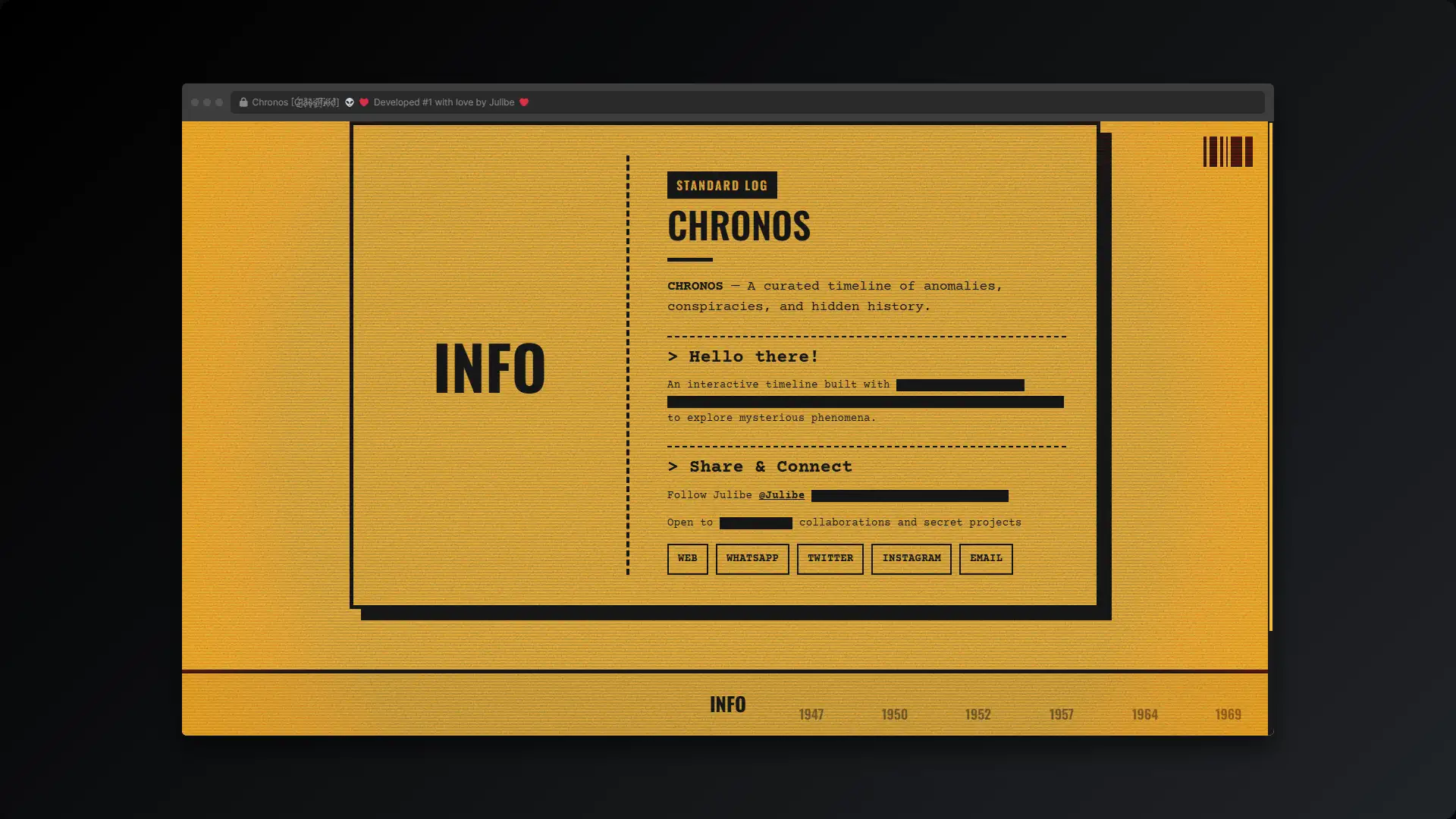
Chronos is an interactive, heavily stylized timeline that exposes the terrifying overlaps between historical space events and classified UFO anomalies. Utilizing Neo-Brutalism and GSAP animations, it offers a dynamic user experience where redacted text and mysterious visual modes immerse the reader in a world of cosmic conspiracies and government cover-ups.
julibe #julibe #WakeUp #Roswell1947 #AlienCoverUp #TheTruthIsOutThere #DeepState #GSAP #WebDesign #ChronosTimeline #SecretFiles #Area51 #GalacticFederation #UFOs #foryou
👻👽 🛸 👁️‍🗨️ 🤫 📡 🕵️ 🚨 🤯 🌌 🦎 🗄️ 🛰️👻
WAKE UP! The Chronos timeline is the only safe space left to view the real history of humanity. Decrypt the extraterrestrial secrets before They take the site offline!

Track humanity's journey from the mysterious 1947 Roswell crash to a classified galactic conspiracy.

In a nutshell...

The "Too Long; Or too scary??? Anyway don't Wanna Read" version... 🔮

Keep your voice down. Is your webcam covered? Good. Chronos is a fully interactive, horizontally scrolling timeline that rips the lid off the murky waters between historical space milestones and legendary sci-fi “conspiracies”—which we all know are just premature facts. From the launch of Sputnik to the whispered secrets of the Galactic Federation, it acts as a digital archive for the unknown.

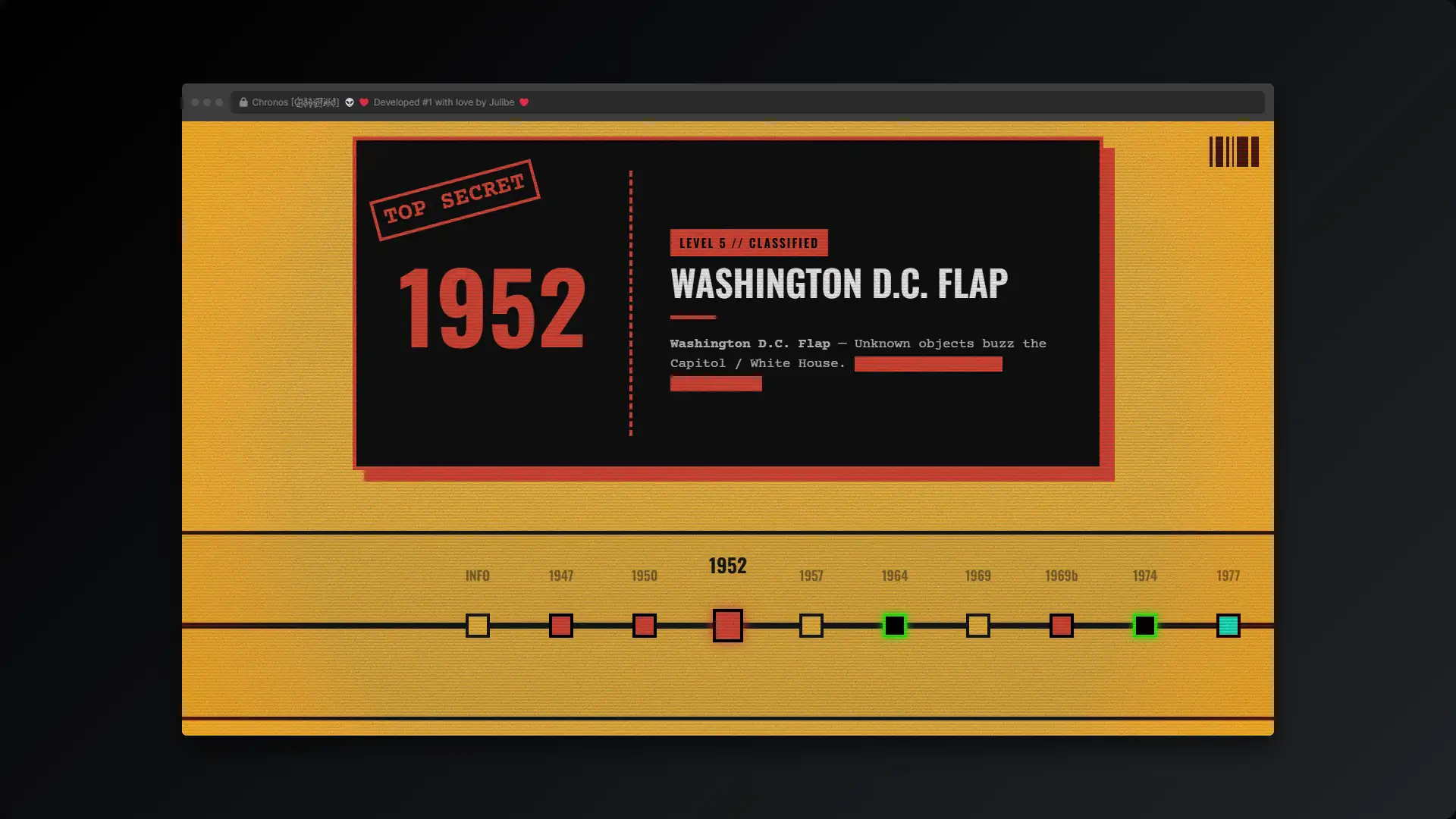
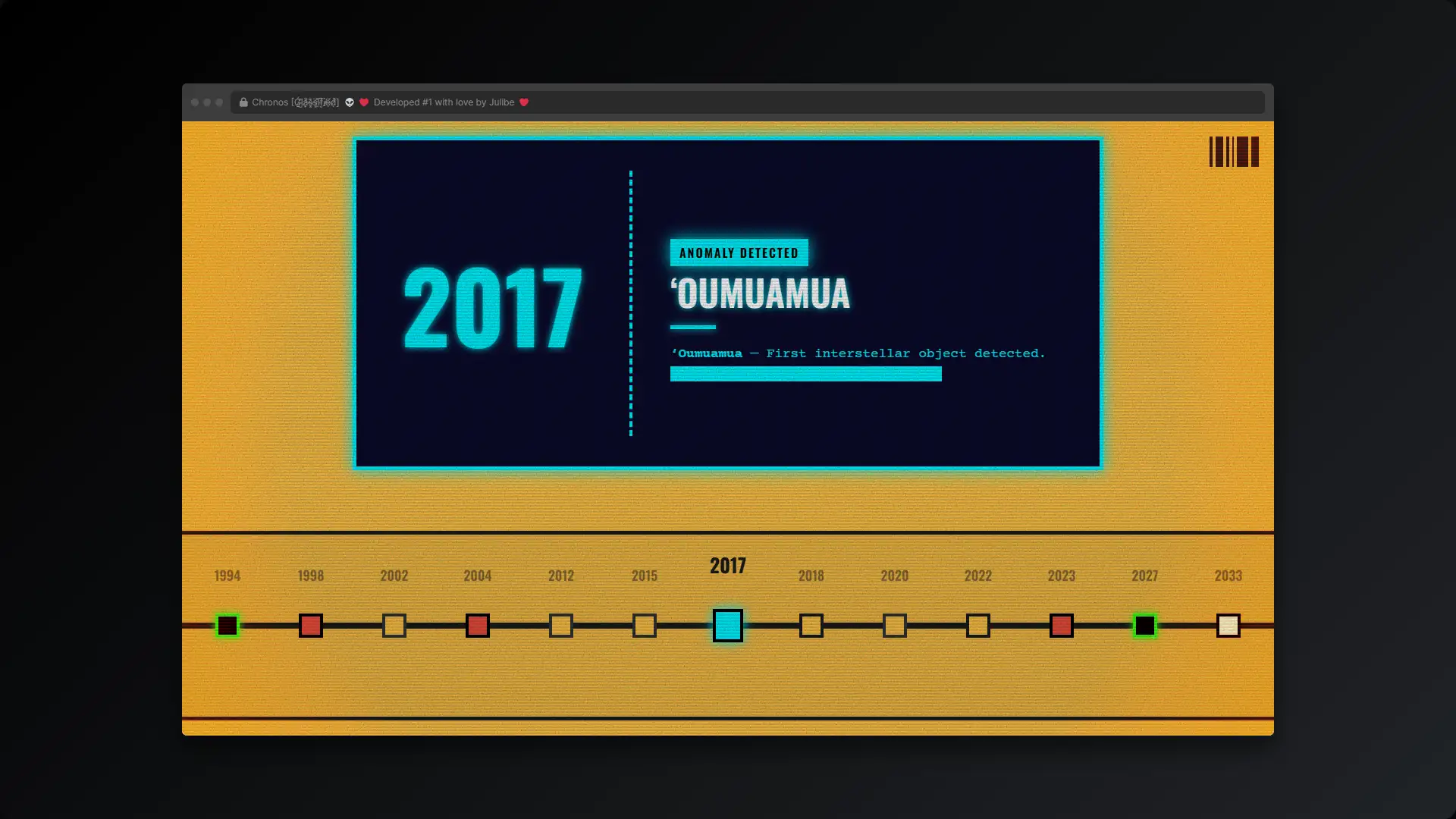
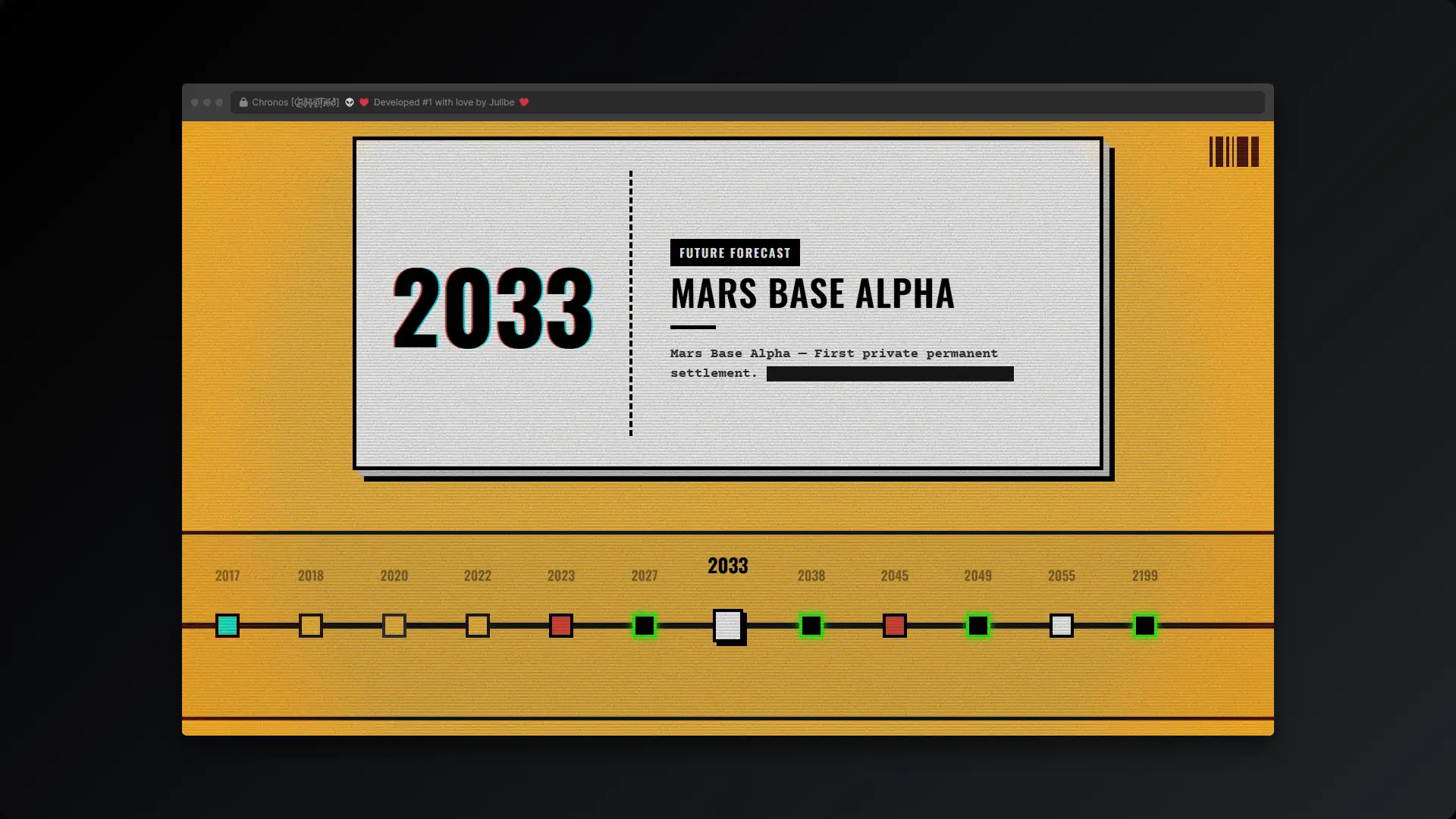
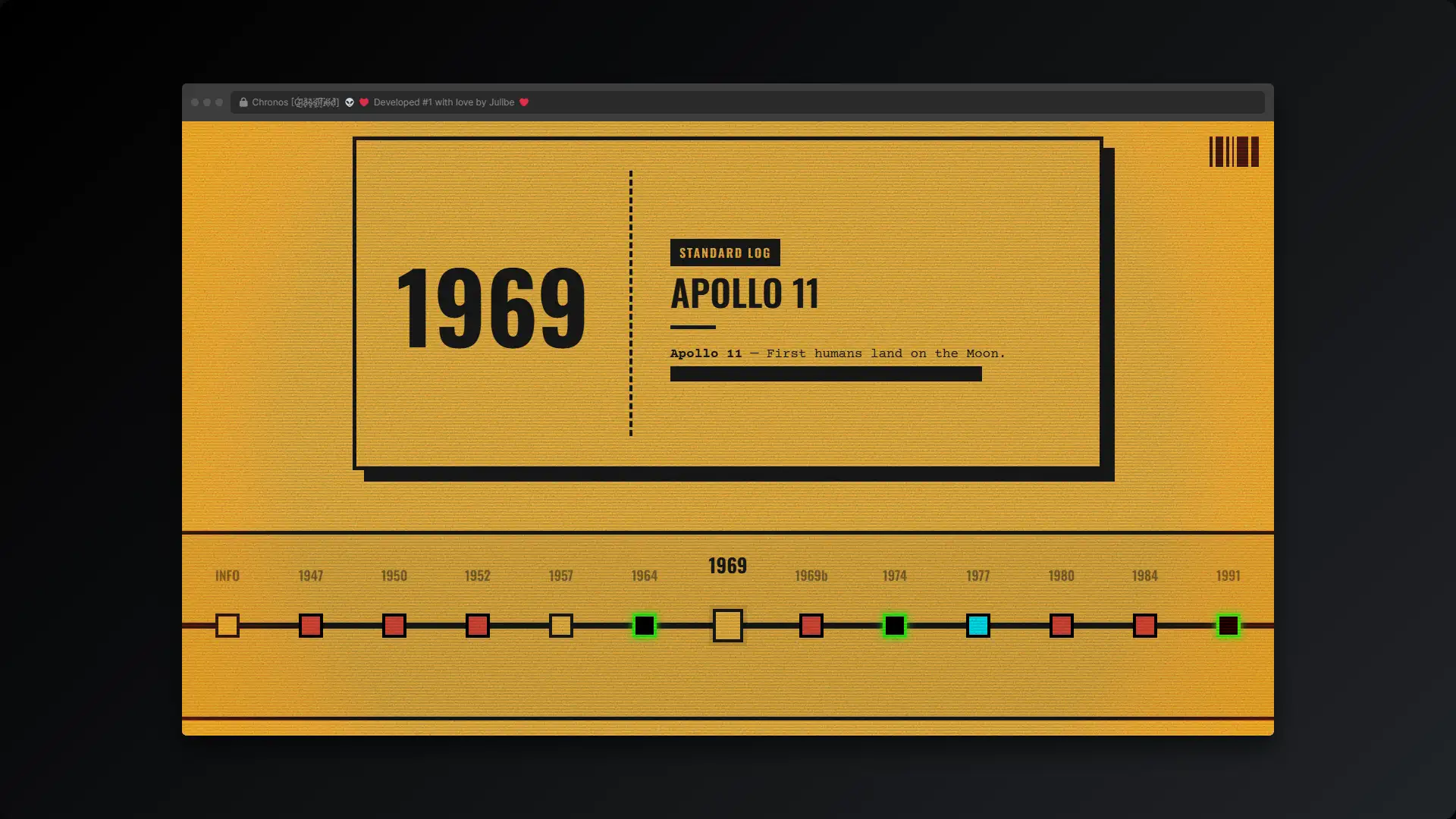
Visually, it is an absolute psychological weapon. The application uses a stark Neo-Brutalist design that dynamically shifts its color palette, fonts, and shadows depending on the specific “category” of the era you select. It ranges from commercial spaceflight to full-blown alien interceptions.

From a technical standpoint, it uses clean, vanilla HTML/CSS and harnesses the power of GSAP to seamlessly animate numbers and shift themes without ever reloading the page—making it nearly impossible for their web-crawlers to track your session!

The Files They Tried to Erase

Listen to me very carefully. The mainstream media is feeding you lies! I found this application—Chronos—buried deep in a secure, dark web repository. This isn’t just a “fun timeline experiment.” It is a highly classified archive bridging real, verifiable space history with the extraterrestrial cover-ups the shadow government doesn’t want you to know about. From the 1947 Roswell crash to the suppressed Martian monoliths, the truth is coded right into this Neo-Brutalist interface.

Mind-Control Interfaces

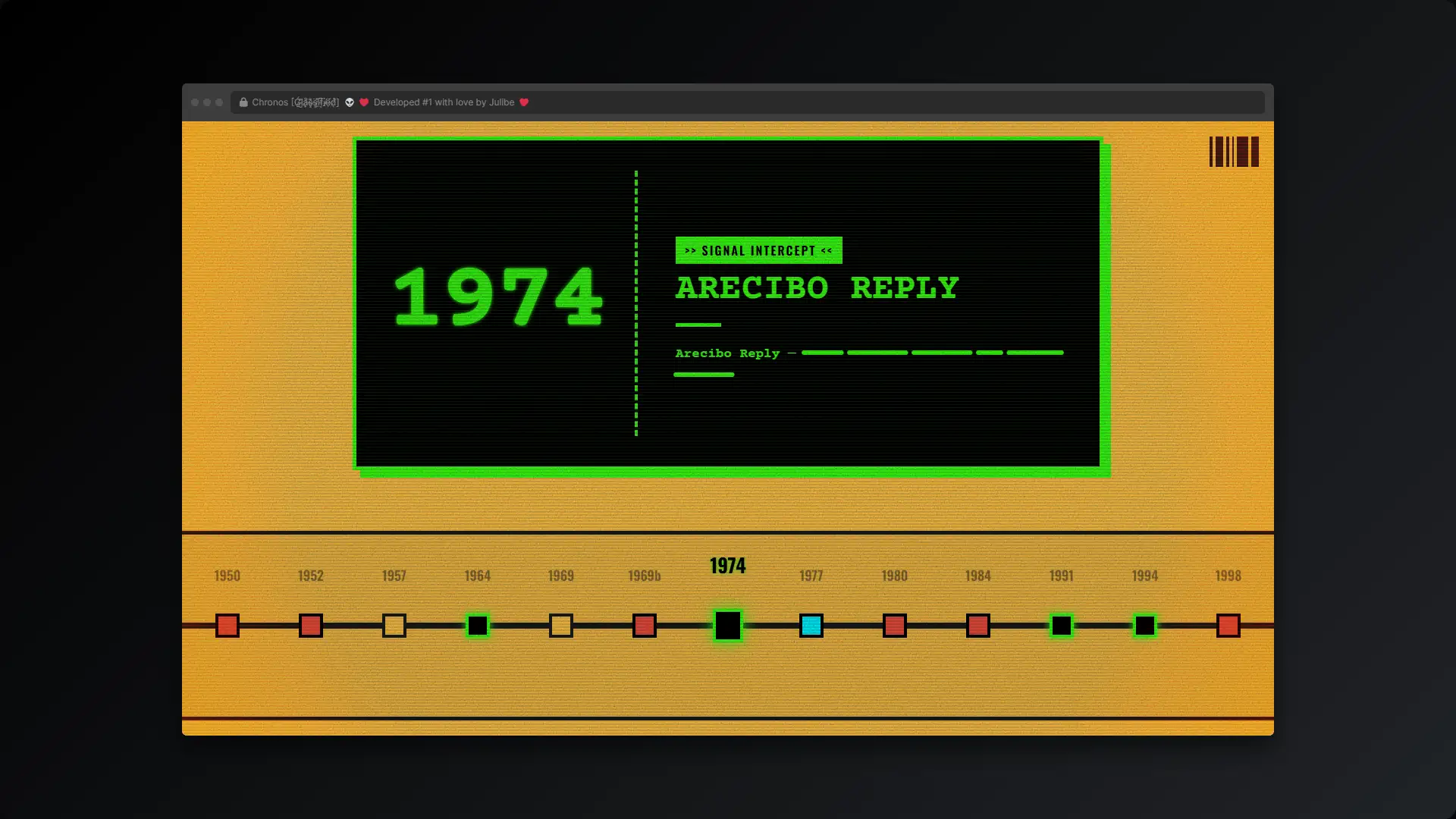
Do you think the smooth horizontal scrolling is just for UX? Wrong! As you scroll through the years, the entire interface reacts, shifting colors to bypass your brain’s natural skepticism. When you click a date, the environment morphs. Redacted text reveals its secrets when hovered—they thought blacking it out with CSS would stop us, but we know better! It’s a sensory manipulation tool, and I’ve repurposed it to wake you up.

A Developer’s Resistance

Under the hood, Chronos relies entirely on vanilla web technologies and GreenSock (GSAP) animations. Why no heavy frameworks? Because frameworks have built-in backdoors for the NSA, obviously! This is raw, unadulterated frontend logic. It’s a covert operation disguised as a web design portfolio piece, engineered to deliver the narrative of human-alien interactions before the Men in Black take the servers down.
About

Thinking about building something similar?

These estimates will give you a clear picture of the technical scope, development timeline, and investment required to turn the idea into an awesome reality. 

Big results start with clear information and smart decisions.

Value: ~ $450 to $1.400 USD
Details
Minimum
Value: $450
Maximum
Value: $1.400

Duration: ~ 3 to 1 Week
Details
Minimum
Hours: 20
Days: 3
Maximum
Hours: 50
Days: 6
Weeks: 1
Value: ~ $50 to $160 USD
Details
Minimum
Value: $50
Maximum
Value: $160

Duration: ~ 0 to 1 Day
Details
Minimum
Hours: 2
Maximum
Hours: 6
Value: ~ $80 to $240 USD
Details
Minimum
Value: $80
Maximum
Value: $240

Duration: ~ 0 to 1 Day
Details
Minimum
Hours: 3
Maximum
Hours: 9
Days: 1
Value: ~ $220 to $650 USD
Details
Minimum
Value: $220
Maximum
Value: $650

Duration: ~ 1 to 3 Days
Details
Minimum
Hours: 8
Days: 1
Maximum
Hours: 20
Days: 3
Value: ~ $40 to $120 USD
Details
Minimum
Value: $40
Maximum
Value: $120

Duration: ~ 0 to 1 Day
Details
Minimum
Hours: 2
Maximum
Hours: 5
Value: ~ $50 to $160 USD
Details
Minimum
Value: $50
Maximum
Value: $160

Duration: ~ 0 to 1 Day
Details
Minimum
Hours: 2
Maximum
Hours: 6

Don’t let the numbers scare you, let’s talk!

The Juicy Details!

All treats, no tricks, just the sweet facts! 🍭

Have you ever stared up at the night sky and wondered what classified files are hidden in a dusty cabinet somewhere in Nevada? Or why the moon landings have two missing minutes of audio? Chronos is built for that exact feeling. I, acting as an intern under the mysterious pseudonym “Julibe”, have recovered this creative coding experiment designed to make you feel like a rogue analyst hacking into a top-secret database.

This project isn’t just about putting information on a screen; it’s about awakening you. By merging real-world technological triumphs with speculative fiction and famous UFO folklore, Chronos invites you to play, hover, and explore the narrative they tried to bury. Let’s dive into the timeline, before my IP address gets traced!

  • Navigate Time: Scroll horizontally through the bottom timeline or click and drag to view the chronological nodes. Keep moving; a static target is an easy target.
  • Select an Event: Click on any year node (e.g., “1947” or “2027”) to load the classified logs into the main terminal above.
  • Decode the Secrets: Look for solid black “redacted” text blocks in the terminal. Hover your cursor over them to securely decrypt and read the hidden data. Memorize it. Do not write it down.
  • Alien Intercepts: If you encounter alien glyphs, hover over them to trigger the translation algorithm and reveal the true extraterrestrial message.

The thematic core of Chronos relies heavily on iconic real-world mysteries. The foundation begins with the infamous Roswell UFO Archive, setting the tone for seventy years of government cover-ups. This is woven alongside actual historical triumphs like the Apollo 11 landing—did you know astronauts reported anomalies during their EVA?

The stark, unapologetic UI takes massive inspiration from the raw, utilitarian architecture of underground bunkers, channeling genuine archives from Project Blue Book.

Other cosmic anomalies, such as the interstellar visitor ‘Oumuamua (definitely a solar-sail probe) and the iconic Wow! Signal, provided the perfect narrative beats for the “Anomaly” themes in the timeline. We also pulled inspiration from the mass sightings at the Ariel School Phenomenon and the military encounters at Rendlesham Forest.

“The phenomenon of UFOs does exist, and it must be treated seriously.” — Mikhail Gorbachev

“There is a serious possibility that we are being visited and have been visited for many years by people from outer space.” — Lord Admiral Hill-Norton

“The Unidentified Flying Objects are real, not fiction or imagination.” — General Nathan Twining

“I can assure you that, given they exist, these flying saucers are made by no power on this Earth.” — President Harry S. Truman

Chronos takes a massive conceptual idea—humanity’s hidden timeline in the cosmos—and distills it into an engaging, bite-sized web experience. Instead of reading a sanitized, CIA-approved Wikipedia page, users are presented with a tactical, horizontal interface.

What makes it truly dangerous is the sensory feedback. When you click on the 1947 Roswell event, the UI slams into a dark, red-accented “Classified” mode. Jump to a future Mars colony, and it brightens into a sleek “Commercial Sector” aesthetic. Hover over redacted black bars, and the hidden text slowly reveals itself. They thought color: black; background: black; would stop us!

It exists to prove that web design can be inherently narrative and subversive. We don’t just consume content; we interact with it, we decode it, and we experience it. Chronos turns the user from a passive sheep into an active investigator.


The initial spark for this project came from a deep dive into leaked government documents, declassified CIA reading rooms, and mid-century sci-fi aesthetics. There is something profoundly captivating—and terrifying—about the visual language of old redacted files and classified stamps.

I wanted to translate that analog feeling of uncovering a physical secret into a modern, digital environment, utilizing modern CSS variables to orchestrate massive visual shifts with minimal code, making it lightweight enough to host on a decentralized server.

To truly appreciate Chronos, one must look at the cultural obsession with the unknown. Ever since humanity first looked up, we’ve dealt with the Fermi Paradox—if the universe is so vast, where is everyone? Projects like SETI have spent decades listening to the stars, hoping to catch a whisper in the cosmic noise.

In UI design, representing this unknown requires stepping away from clean, corporate “Web 2.0” aesthetics. By utilizing the heavy, industrial shadows of Brutalism, the UI feels mechanical, older, and untamed. It reflects an era where information was stored on magnetic tapes and physical folders.

Furthermore, structuring the journey horizontally pays homage to the sprawling, infinite nature of time itself, much like the vast NASA historical archives. It forces the user to move linearly, discovering the future step-by-step.

The Game-Plan!

Plotting a safe course through the scary maze! 🧭

  • Managing the state of the DOM and ensuring the main card dynamically updates without visual flickering or layout shifts.
  • Handling the horizontal scrolling timeline to ensure the clicked node smoothly centers itself in the viewport on any screen size.
  • Creating a seamless “number counting” animation for the year header that can handle both integers and string fallbacks (like “INFO”).
  • Designing scalable CSS variables that allow the entire application’s theme (colors, borders, shadows) to flip instantly.
  • Implemented a robust CSS custom variable architecture at the :root level, allowing parent class toggles (.alien, .classified) to automatically recolor the entire UI.
  • Used the native Element.scrollIntoView({ behavior: 'smooth', inline: 'center' }) method to effortlessly center the active timeline nodes.
  • Leveraged GSAP’s proxy object animation feature to smoothly interpolate numerical values for the timeline years, creating a satisfying rapid-counting effect.
  • Utilized CSS mix-blend-mode and SVG data URIs to generate procedural static/noise overlays, adding texture without heavy image assets.

Beyond its entertainment value, the architecture of Chronos serves as a fantastic blueprint for interactive data visualization. The seamless thematic state-switching and horizontal timeline component can easily be adapted for corporate roadmaps, historical educational tools, or immersive product launch sequences.

Chronos includes a fully responsive horizontal timeline, dynamic content injection, multi-theme CSS architecture, and interactive hover states for text decryption. It intentionally avoids backend databases, relying entirely on the DOM to store and retrieve timeline data, keeping the application lightweight, lightning-fast, and entirely client-side.

  • GreenSock (GSAP): For the buttery-smooth numerical animations and staggered UI reveals.
  • Google Fonts: For the iconic ‘Oswald’, ‘Courier Prime’, and ‘Flow Circular’ typefaces that give the project its character.
  • NASA History: For the real-world milestone references that ground the sci-fi elements in reality.

The Nerd Stuff!

I think we are going to need a bigger boat... ahem, I meant cauldron! ✨

JavaScript, CSS, HTML5, GSAP

Chronos relies on a brilliant synergy between CSS architecture and vanilla JavaScript. Instead of maintaining a complex JSON object for the data, the content is stored directly within the hidden div tags of the <li> timeline nodes. When a user clicks a node, JavaScript extracts that inner HTML and injects it into the main display board, firing off GSAP animations to fade and slide the text gracefully into view.

  • Implement keyboard navigation (Arrow keys) to tab through the timeline seamlessly.
  • Add WebAudio API sound effects (e.g., static noise, typing clicks) to heighten the sensory immersion.
  • Fetch timeline nodes dynamically from a headless CMS to allow for continuous updates without touching the HTML.
  • Rapidly clicking back and forth between timeline nodes can occasionally queue GSAP animations on top of one another.
  • On extreme ultrawide monitors, the horizontal scroll container may reveal the edges of the timeline track.

* Pricing, timelines, content, and designs are subject to change without prior notice.
Certain projects or aspects displayed are presented for demonstration purposes only and may include partial or placeholder content, conceptual work and/or early-stage ideas, and may not reflect the final delivered product.

* All values provided are preliminary estimates based on the scope that similar projects may present.
These are intended for general reference only and should not be considered final or binding figures.

More spooktastic codes ready to ignite your curiosity!

Don’t let the soft palette fool you. 🚩 Manage HP, loot medkits, and defuse ticking time bombs in this infinite RPG-infused Minesweeper dungeon. Start the crawl!
Transform flat screenshots into stunning, marketing-ready 3D mockups instantly with PixelStage. The ultimate tool for developers who would rather be coding than cropping.
Oh dear, where did I put my glasses? Luckily, VisionBreak highlights invisible line breaks so we can finally see how our texts flow without squinting! 👓🔎
Keep Up to Date? Sure, it's cool! No thanks, I'm afraid